Business technology consulting · West Michigan

Practical software and responsible AI adoption for West Michigan businesses.

Arnhem Advies helps West Michigan businesses untangle the workflows they've outgrown, build the systems generic software can't cover, and adopt AI with clear eyes about cost, risk, and quality.

Built for

  • Your workflow lives in spreadsheets, inboxes, paper, or disconnected tools.
  • Handoffs between office, field, customers, or vendors create rework and missed details.
  • Your current software almost fits, but every week costs you another workaround.
  • You want to use AI, but need clarity on cost, risk, quality, and governance first.

Services

Consulting first, with the ability to build and host the system.

The work starts by understanding the business workflow. When custom software is the right answer, Arnhem Advies can design, build, and host it.

Business Technology Consulting

Map the workflow, name the real problem, and decide whether the answer is a process change, a better tool, custom software, or AI — in that order, not the reverse.

  • Workflow and requirements discovery
  • Process cleanup and system selection
  • Vendor, tool, and architecture decisions
  • AI use-case evaluation

Custom Systems, Web Apps, Websites, and Hosting

Design, build, and run practical software for the parts of the business where off-the-shelf tools are too loose, too rigid, or too disconnected.

  • Internal tools, dashboards, and portals
  • Scheduling, reporting, and field/office workflows
  • Service websites with contact or quote flows
  • Cloudflare, Vercel, Supabase, DNS, and deployment setup

Responsible AI Adoption

Put AI to work where it creates real leverage — with operating practices for token cost, model choice, review gates, and verification, so speed never comes at the expense of trust.

  • Token-cost planning and budgeting
  • Model tiering by risk and complexity
  • Change control and review gates
  • Verifiable workflows: tests, types, reproducible checks

The work

Things I've built, and how they behave.

Real systems, described plainly. Where something is still in testing, it says so.

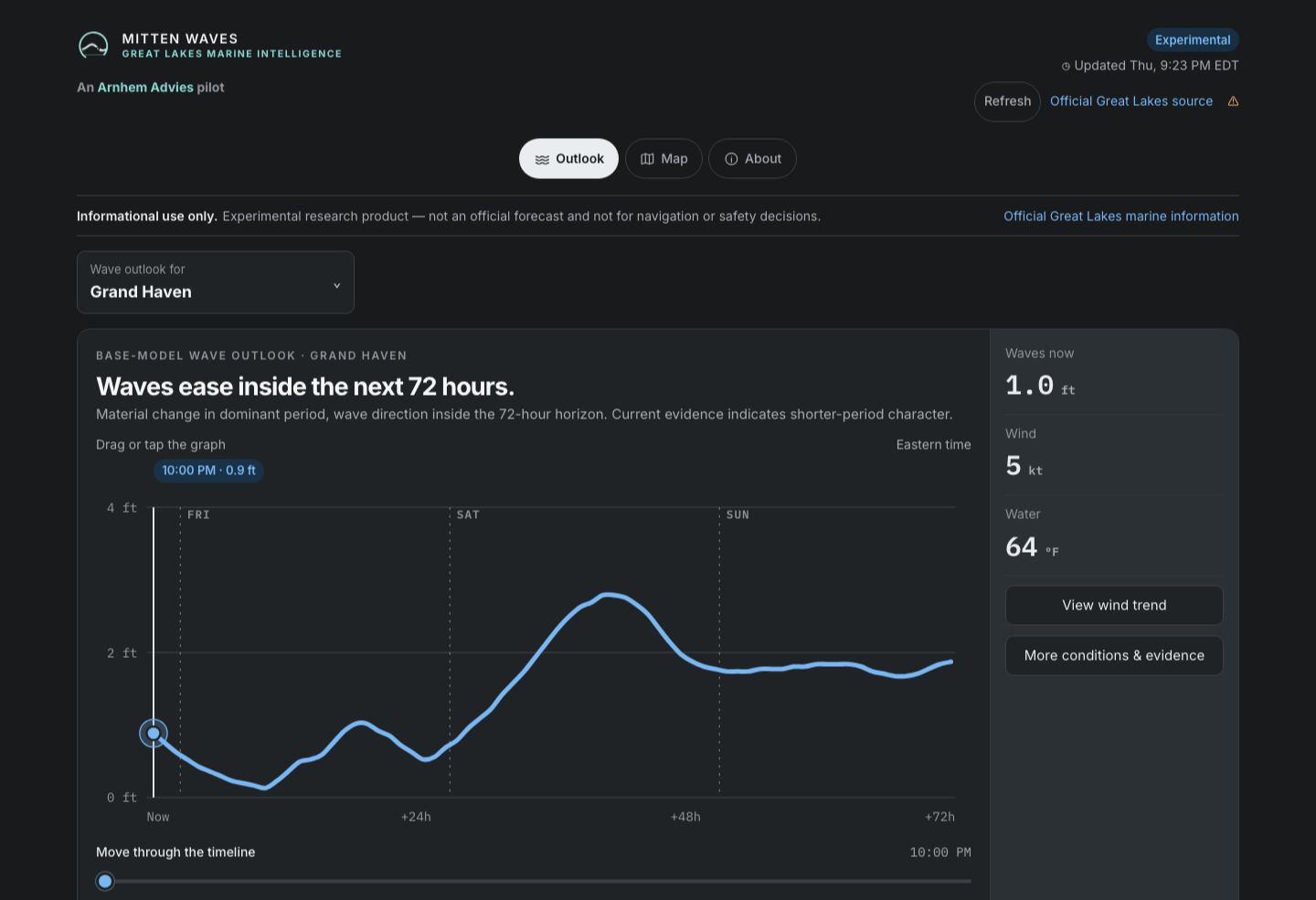
The Mitten Waves wave outlook for Grand Haven: a 72-hour forecast chart beside current wave height, wind speed, and water temperature.

Mitten Waves

Live

Marine forecasting that keeps score against the lake.

113 million historical observations · 29 stations · 2005–2025

A wave and weather platform for Holland, Grand Haven, and Muskegon. It reads live buoy data and federal model output, then does the part most forecasts skip: it keeps score. Every prediction is matched against what the water actually did, so the system can learn where the public model runs high or low — at a particular harbour, a particular number of hours out. Underneath sits two decades of Lake Michigan history, so an idea can be tested against real weather — including the rough days that actually matter — before anyone relies on it. That archive is deliberately walled off from live coverage, because history that quietly passes for current conditions is how you fool yourself. Raw data is stored untouched before anything reads it, so any past forecast can be replayed exactly as it was known at the time; without that you cannot tell a real improvement from hindsight. And until the evidence clears its own bar, the site says so: the model reads “calibrating,” every value is labelled forecast or observation with its source and timestamp, and nothing is invented to fill a gap.

Visit Mitten Waves
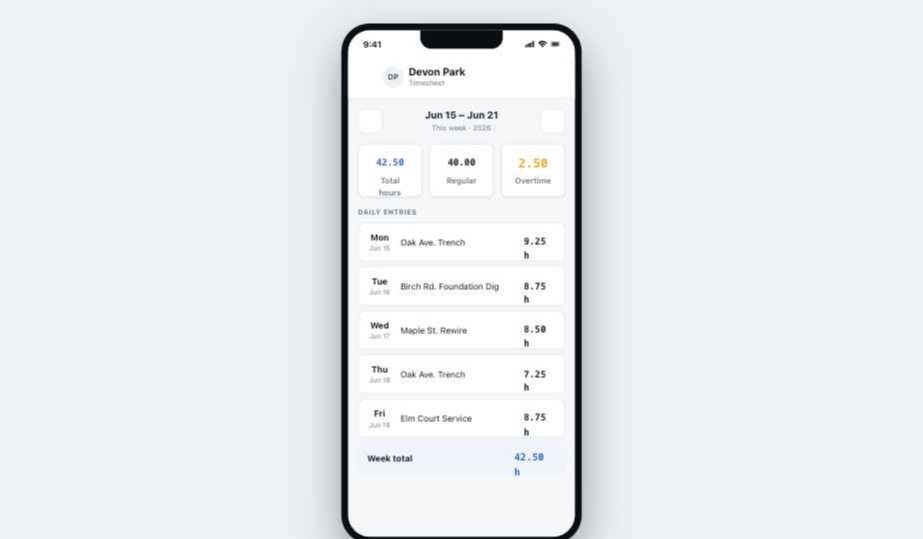
A crew member's weekly timesheet on a phone, showing daily entries by job with regular and overtime hours totalled.

A field-operations platform for trades businesses

In private testing

Built end to end — the crew's app, the office console, and the database underneath both.

Crews keep working in a basement or a truck with no signal; the office sees the work the moment it syncs. Time and job records carry through to payroll with the accuracy payroll demands. Scheduling, check-ins, approvals, and reporting live in one place instead of five.

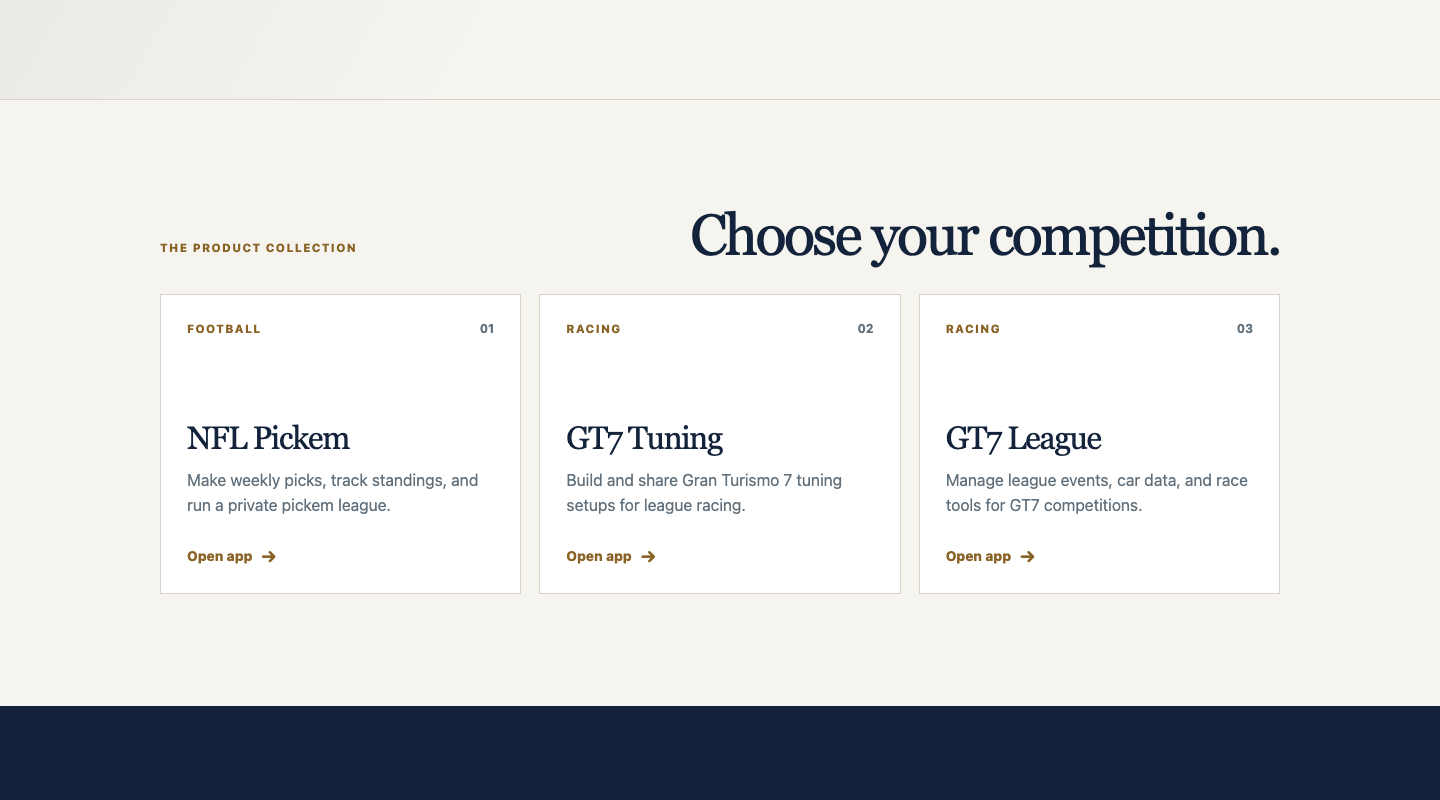
The Group Competitions product collection: NFL Pickem, GT7 Tuning, and GT7 League, each with its own card.

Group Competitions

Live

A small product family, shipped and running.

Three live applications for people who run leagues and competitions, sharing one account system and one design language. Evidence that the work gets finished, deployed, and operated — not just prototyped.

Visit Group Competitions

Engineering range

The work spans edge-hosted web apps, data-backed business tools, internal portals, automation and integration services, practical websites, and hardware-adjacent operational utilities. The point is not the subject matter of each build; it is choosing the right architecture, shipping the workflow, and proving it works.

Edge-hosted web appsData-backed business toolsDomain-specific calculators and enginesInternal portals and dashboardsAutomation and integration toolingPractical websites and hostingHardware-adjacent operations tools

Point of view

More engineering, less software.

AI has made writing code nearly free. What it cannot supply is judgment: knowing what to build, what “correct” means in a domain where wrong has consequences, and when to reach for AI and when not to. A tool that amplifies is only as good as what you give it to amplify — point it at judgment and you get leverage; point it at confusion and you get confusion, faster. Arnhem Advies is built on the judgment side of that line.

Responsible AI Adoption

Use AI where it creates leverage, with practices that manage cost and risk.

Estimate token costs

Treat AI usage as a visible project cost line with a plan behind it — not a vague tooling expense that surprises you at invoice time.

Choose the right model tier

Route work by risk and complexity: don't overspend premium models on routine tasks, and don't underpower the work that has to be right.

Gate risky changes

Put review and verification wherever AI output can touch data, money, permissions, compliance, or customer trust. Speed with a gate, not instead of one.

Verify the workflow

Prefer stacks and processes where tests, types, reproducible environments, and acceptance checks can prove the work — so trust rests on evidence, not vibes.

Get a second opinion that isn't the same opinion

Work that touches money, customer data, or permissions is reviewed by a different family of AI model than the one that wrote it. Models from the same family tend to be wrong in the same ways — and to agree with each other while being wrong.

Prove the test can fail

A check that has never failed isn't evidence. Before one is trusted to guard your business rules, it gets deliberately broken to confirm it actually notices. One review session found 40 checks reporting success while structurally unable to see what they claimed to verify.

About the founder

The person who has done your paperwork — and can build the fix.

Most software fails small operating businesses for one reason: the person who understands the work is never the person who builds the system. Requirements pass from operator to analyst to engineer, and intent leaks at every handoff. Arnhem Advies exists to remove that translation layer.

For fifteen years, Eric Gelder did the invoicing and helped with operations for a small excavating company. That is where the useful education happened: what it costs when a job's details live in one person's memory, what payroll week feels like when the timesheets are on paper, and how much margin leaks quietly between the work getting finished and the invoice going out.

He has also spent two decades solving those same problems at scale — a decade underwriting farm and commercial insurance and writing the methods and procedures an operation runs on, then owning the core underwriting and billing systems of a large insurer, then leading AI products across insurance and banking where being wrong had consequences. Different size, identical failure modes: work that lives in people's heads, handoffs that lose detail, and software that almost fits.

AI has now removed the last barrier between that judgment and shipped software. Eric designs, builds, and operates complete systems directly — the work above — with the discipline the regulated years demanded: requirements written down, changes reviewed, correctness proven rather than assumed.

In one line: hire someone who has kept the books for a business like yours and can build the fix himself — not a developer who needs your work explained, and not a consultant who needs a team to translate.

The arc

  1. Small-business operations

    Fifteen years of invoicing and operations for a small excavating company — where the same few people quote the work, do the work, and bill for it.

  2. Regulated operations

    P&C insurance underwriting, methods & procedures, and a paperless imaging transformation — ten years of living the workflows, not observing them.

  3. Enterprise product ownership

    Product owner for core underwriting and billing systems through a Guidewire PolicyCenter transformation; built enterprise-wide UAT practice.

  4. AI product leadership

    Technical director for AI solutions across insurance and banking — GenAI, computer vision, document ingestion — in HIPAA-sensitive, on-premise deployments.

  5. Builder

    Now ships complete production systems directly, with AI handling execution and the founder holding every decision — no team, no translation layer.

How this starts

Small first step, and you keep what you pay for.

No retainer, no long proposal, and no commitment to a big build before anyone knows what it should be.

  1. Free

    A conversation

    You describe the problem in your own words. I tell you straight whether software is even the answer — often it's a process change or a tool you already own, and that's a fine outcome.

  2. Fixed fee

    A discovery step

    If it's worth going further, I map the workflow, find where the time and margin actually go, and write it down as a plain recommendation. That document is yours to keep — including if you take it to someone else, or decide to do nothing.

  3. Scoped from discovery

    Build it, if it makes sense

    Only once we both know what the system needs to do and what finished looks like. Priced against a scope you have already read.

Client Intake

Tell me what you're trying to build

Describe the workflow, system, website, or AI adoption problem in your own words — rough is fine.

You'll hear back from me personally, usually within two business days. The first conversation is a conversation, not a pitch — we work out whether there's a real fit.

Your details go to a private intake queue. No mailing list, no drip campaign, never shared.

Your submission is used only to evaluate and respond to your inquiry.